
Visit Studley
Studley, the birthplace of Patrick Henry, is open to the public from sunrise to sunset, every day of the year. The site is self-guided. An interpretive marker stands near the archaeological footprint of the manor house.
Hours: Sunrise to sunset
Admission: Free
Address: 9620 Studley Farms Dr.
Mechanicsville, VA 23116
Parking: Limited parking in the cul-de-sac on site. Please do not block driveways and/or mailboxes. If you would like a guided tour, please use the link below.
Studley: Birthplace of Patrick Henry
Nestled in eastern Hanover County where modern residential communities meet farm fields worked for centuries, Studley stands as the site of the colonial-era plantation home where Patrick Henry, the "Voice of the Revolution,” was born.
Origins of the Property
Studley, a 600-acre tobacco plantation, included a manor house built in the 1720s by Colonel John Syme for his second wife, Sarah Winston Syme. Following Colonel Syme's death in 1731, Sarah became a widow and remarried shortly thereafter. Her new husband was a Scottish immigrant named John Henry. John Henry quickly became a respected member of the community, working as a surveyor and mapmaker, serving as a colonel of the militia, and eventually becoming justice of the peace for Hanover County.
Birth of a Revolutionary
Patrick Henry was born at Studley on May 29, 1736. He was the second Henry child born at Studley. Patrick spent his early childhood on the 600-acre farm with an older stepbrother, brother, and seven younger sisters. Patrick Henry attended a local school until the age of ten and also received instruction from his father in the classics and theology. A childhood friend remembered his affinity for music and recalled that Henry could often be found "lying under the shade of some tree" observing the natural world.
According to his father’s will, when Patrick’s stepbrother, John Syme, Jr., came of age, he received his father’s lands and became owner of Studley as well as all of his father’s acreage. Studley then became the property of John Syme II. John Henry and his wife Sarah Winston Syme then moved their young family, including Patrick, to a new home called Mount Brilliant in western Hanover County.
The Plantation and Its People
Surviving insurance declarations from 1796 and 1805 show a two-story brick house of about 40 by 30 feet with a one-story brick wing. The 1805 declaration also lists a small porch. The house was surrounded by a variety of outbuildings, including a kitchen, dairy, study, stables, barn and granary. It was surrounded by a variety of outbuildings including a kitchen, dairy, study, stables, barn, and granary. Mainly through the work of Studley's enslaved population, both John Henry and his predecessor John Syme raised tobacco on the plantation and exported it to English markets. The partially cured tobacco leaves were packed tightly in large hogsheads and shipped from nearby Page’s Warehouse on the Pamunkey River.
Loss and Legacy
The Studley manor house was destroyed by fire in 1807, and now only archaeological remnants remain. In 1995, Preservation Virginia purchased the property to ensure its protection and preservation. The site was listed on the National Register of Historic Places in 1982. Scientific excavation of Patrick Henry's Birthplace Archaeological Site could yield new insights into the early life of the noted patriot. Today, the site is interpreted through a Road to Revolution historical marker near the archaeological footprint at 9620 Studley Farms Drive.
The Man Who Shaped a Nation
Henry was the first elected governor of Virginia, a devoted father of 17 children, and the most famous orator of his day. His 1765 resolutions against the Stamp Act articulated the basic principles of the American Revolution. Henry is perhaps best known for his immortal words “Give me liberty, or give me death!” Which he delivered during the Second Virginia Convention at St. John’s Church in 1775. His impassioned words helped move colonists toward American independence. Henry's political career included 26 years of service in the Virginia legislature and five terms as governor. He helped draft the Virginia Constitution of 1776.
HPCF's Work at Studley
The Historic Polegreen Church Foundation (HPCF) cares for Studley along with two other National Register-listed historic properties in Hanover County. Our goal is to turn this open field into a place where visitors can see and understand where Patrick Henry’s story began, through interpretive signage and thoughtful site improvements. With America’s 250th anniversary underway, we are committed to making sure Studley takes its rightful place in the story of how liberty in America began.
How We Know What We Know
Patrick Henry was born at Studley in 1736, but no drawing or photograph of the house from his time is known. What we do have are two fire insurance declarations filed with the Mutual Assurance Society, one in 1796 and one in 1805. They record which buildings stood at Studley, how large they were, how many stories they had, and what they were made of. They do not show what the buildings looked like. The images below are labeled so you can tell the documented from the imagined.
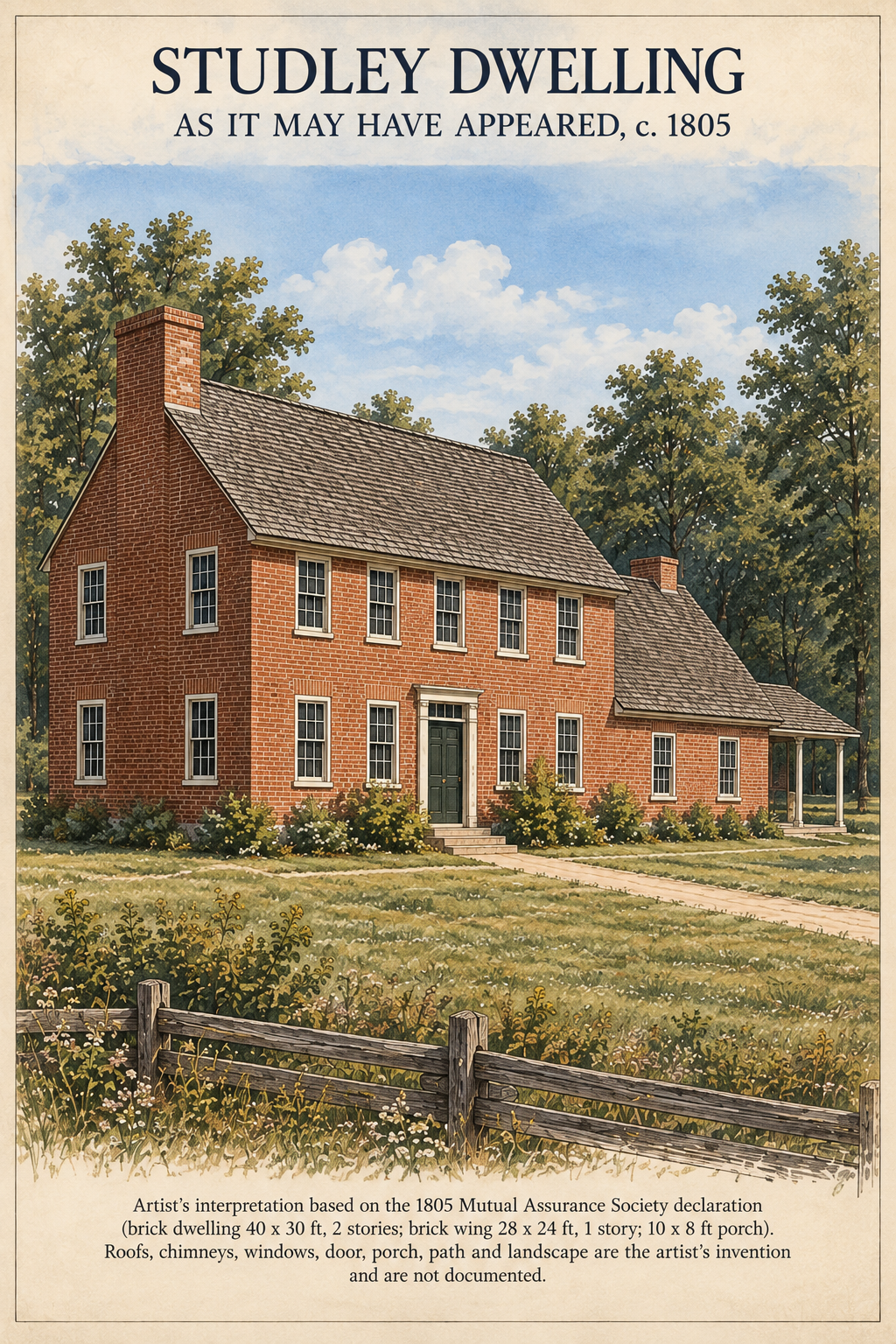
Artist’s interpretation only. This painting shows how the Studley dwelling may have looked around 1805. The brick walls, the two stories and the size of the house and wing (40 by 30 feet and 28 by 24 feet) come from the 1805 declaration. The roofs, chimneys, windows, door, porch, path, fence and landscape are the artist’s invention and are not documented.
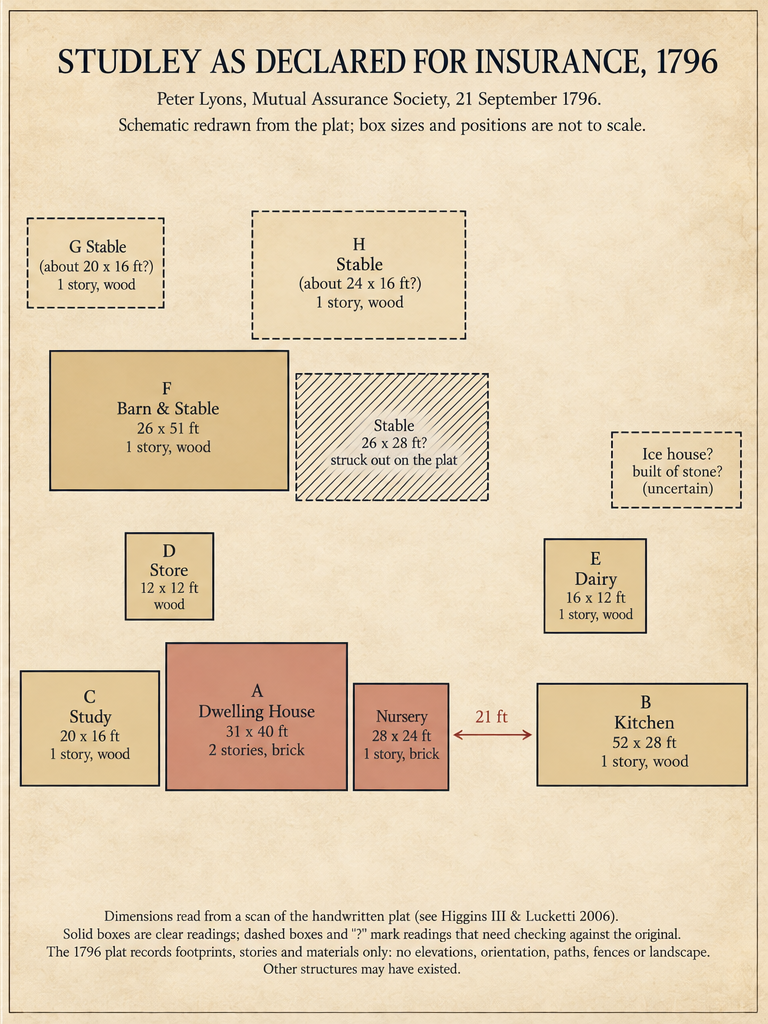
Studley as declared for insurance, 1805. Footprints, materials and stories come from the 1805 declaration, as transcribed by Higgins III and Lucketti (2006). Distances are approximate. Orientation, paths, fences, landscape and any uninsured buildings are not shown.